

Operation Spider’s Web: The Raid That Shook Russia
A story of sabotage, strategy, and what it means when Russia’s bombers burn.

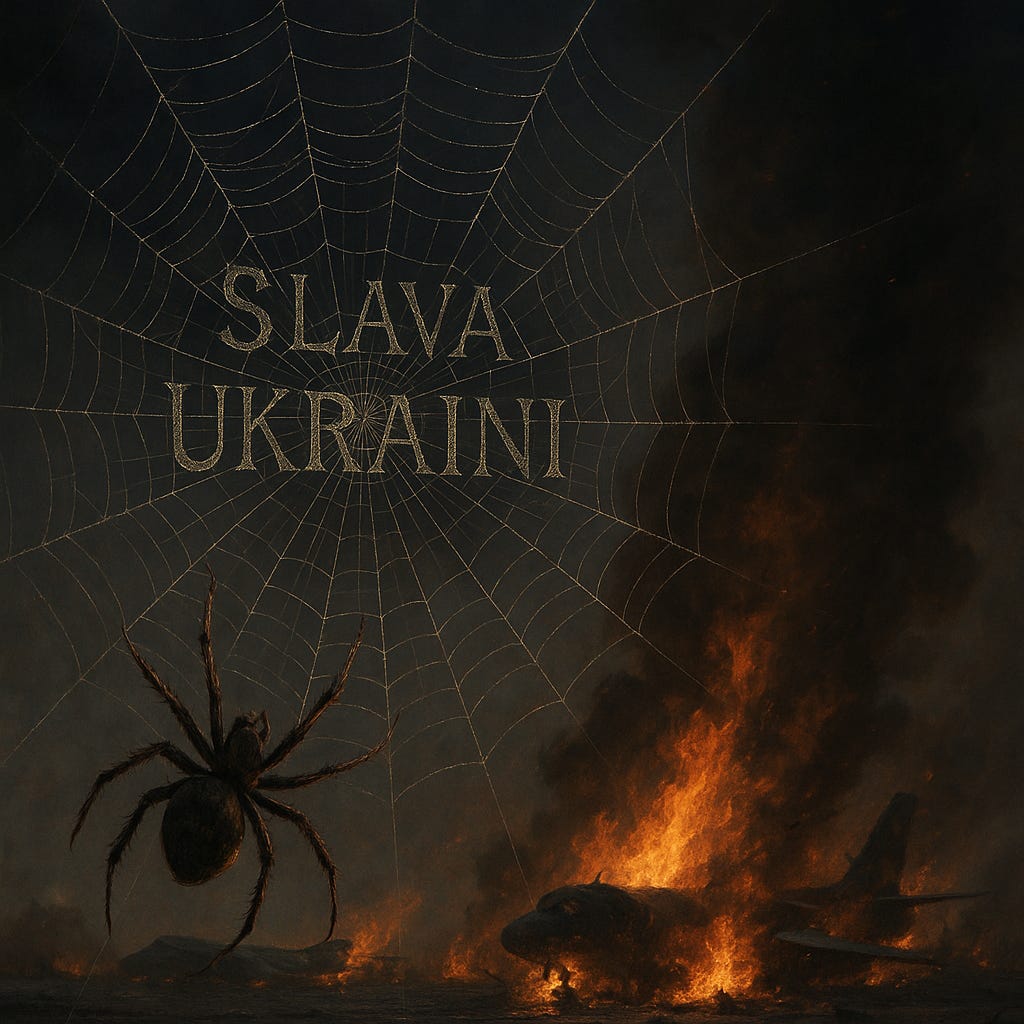
I'm not Ukrainian, but over the past three years, I’ve learned more about Ukraine—its history, its people, and its courage—than I ever expected to.
My professional network has helped to raise millions for humanitarian aid. My clients in the construction industry have helped displaced Ukrainians start new trades careers—skills they’ll one day use to rebuild their country.
Like so many of you, I’ve watched with helpless outrage as Vladimir Putin launched an illegal invasion, driven by a fantasy of imperial restoration. Like you, I was relieved when the initial assault stalled and failed. Like you, I was dismayed when the Donbas fell. And like you, I know this won’t end until Crimea and Donbas are firmly back in Ukrainian hands.
But that day will come at a terrible cost. That’s why I, like you, was glad to see a decisive blow land—and hopeful that it will help bring that day closer.
On the morning of June 1, 2025, something extraordinary happened.
Ukraine launched a coordinated, long-range drone strike that burned through Russia’s airpower and its sense of impunity in one night. Strategic bombers were hit at multiple airbases, at virtually the same time. At least 40 Russian aircraft were reportedly damaged or destroyed—including Tu-95s, Tu-22M3s, and possibly an A-50 airborne radar plane. The attack was launched not from Ukrainian territory, but from inside Russia’s own borders.
The Security Service of Ukraine (SBU) spent over 18 months preparing what it called Operation Spider’s Web. The mission: infiltrate Russian territory, position disguised drone launchers, and coordinate the most daring sabotage operation of the war.
This wasn’t just a tactical win. It was a strategic, psychological, and doctrinal shift. It showed that Russia’s long-range bombers are vulnerable. That distance is no longer defense. And that a plywood shed and a gamepad can now take out a billion-ruble aircraft.
That’s why I wrote this article.
What follows is a five-part deep dive into how it happened, its impact, and what it might mean next. Each section is linked below. You can read them in order or skip to the parts that interest you most. At the end of every entry, you'll find links to return here or continue forward.
🕷️ The Full Web:
Part I: The Sting
What happened, and why it mattered more than most realized.
Part II: The Bait
How Ukrainian operatives smuggled drones, hid them in plain sight, and launched a long range attack within a short distance from their Russian targets.
Part III: The Bite
What was destroyed, and how the math of the war just changed.
Part IV: The Web Tightens
Russia’s scrambled response and the propaganda spiral that followed.
Part V: The Reckoning
What this operation means for the future of the war, diplomacy, and airpower.
In the coming weeks, months, and years, more will be revealed. This assault may well be studied in war colleges when the whole story can be revealed. I’m no military historian but something special definitely happened here. This was a war story—but not just a story of drones. It’s a story of intelligence, discipline, improvisation, and reach.
Clearly written web of words to capture the loose threads adrift in social media air, paying full respect to the sticky simplicity of the Spider's elegant yet deadly threads.
Congratulations to all who executed such an incredible, powerful, and well-planned attack on Russia and their bombers that have been terrorizing Ukraine for the last few years. Experts say Russia lost 34% of its squadron with this highly creative strategy. The loss is over $7 billion.
#Ukraine #PutinWarCriminal