

What the Hell Is Carney Doing?
On the Path to Becoming a Resource Superpower

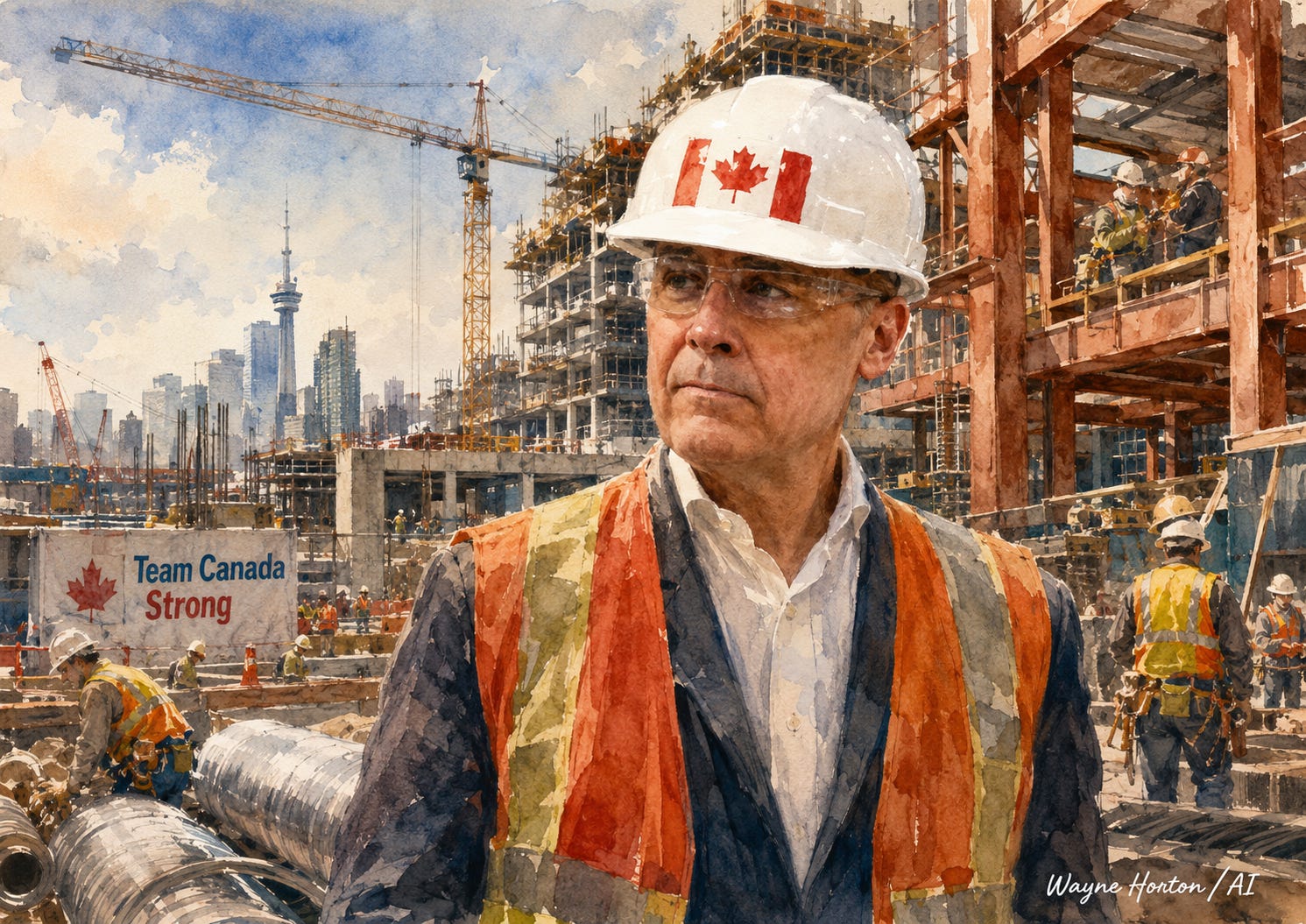
I’ve been spending quite a bit of time with Canadian skilled trades members lately. Recently, we had the opportunity to meet with federal MPs to discuss upcoming opportunities and what will be required to meet them.
In the coming years, Canada will need to add more than 100,000 skilled trades journeypersons to the workforce. Just to keep up. That’s a tall order.
You would think members of the unionized skilled trades would be delighted.
Over the moon.
Instead, in conversation, I find that a significant portion of skilled trades members support Pierre Poilievre and the Conservative Party — a political movement that has been openly hostile to organized labour, including the union structures that turned skilled trades into stable, protected, upper middle-class careers.
Last year, during the election cycle, in a survey, 60 percent of members in one union local were in favour of supporting the Conservative candidate in their riding.
It boggles the mind.
On one side, you have a government promising prosperity and good-paying union jobs for decades to come. On the other, you have a party whose broader movement would weaken the very union structures those jobs depend on, not to mention a provincial government in Ontario that has shown a willingness to use extraordinarily undemocratic constitutional tools against labour rights and union-backed political expression.
Not all union members support the Conservative agenda, of course. Many are thrilled with Mark Carney and the promise he is bringing to their trades. But they are surrounded by a louder contingent of naysayers, and that tends to weaken their resolve.
I was speaking recently with a group of union members who were trying to make sense of what Carney is doing. They were also trying to find rebuttals that might work with their peers.
They wanted to understand the proposal.
Not the slogans. Not the noise. Not the usual partisan shorthand that turns every serious question into a contest over who can be the most dismissive and shout the loudest.
They were trying to understand the underlying idea.
Or as one said very eloquently: “What the hell is Carney doing?”
Why is Carney talking about resources, infrastructure, national capacity, investment, energy, trade corridors, industrial strategy, and sovereignty as though they are all part of the same conversation?
So I asked the simplest question I could think of.
Who owns the oil and minerals in the ground?
There was a pause, because it sounds like a trick question. In Canada, that often means it is.
You could see they were really thinking. They did not want to get caught out or look foolish.
“The Crown?”
“The King?”
“The government?”
“The province?”
“Whichever company leases the rights,” one said, with more confidence than the rest.
All of those answers contain a piece of the legal machinery. None of them gets to the underlying truth of a democracy.
All power comes from the people.
Governments have no power that does not flow from citizens. When we say “the Crown,” we are not really talking about a king or queen. We are talking about a legal vessel that holds certain powers and responsibilities in trust on behalf of the people.
Last May, during an awkward Oval Office visit, Carney interrupted Trump as he mused that Canada might become the 51st state. Carney was unequivocal. He did not say Canada was not his to sell because he personally objected to the idea. He said that he had spoken with the owners of Canada during the campaign, and they had told him Canada was not for sale.
That is the point.
The “Government” does not own Canada.
The “Crown” does not own Canada.
Corporations do not own Canada.
Canadians hold Canada in trust.
That does not mean every citizen owns a private slice of every nickel deposit, oil field, forest, river, or port. It means something more serious. It means that when we are born here, or when we say our oaths, we automatically become lifelong stewards of an enduring public inheritance. We are entitled to use it, develop it, protect it, profit from it, and improve it — but we are not entitled to squander it as though we are the last generation that will ever live here.
That is the difference between ownership and stewardship.
Ownership asks, “What can I take?”
Stewardship asks, “What must I leave stronger?”
That is the foundation of Carney’s argument, whether he states it this plainly or not:
We are obligated to extract the maximum public value from every resource we choose to develop.
Not maximum private profit.
Not maximum government control.
Not maximum short-term revenue.
Maximum public value.
That includes Canadian jobs. Canadian infrastructure. Canadian processing. Canadian innovation. Canadian leadership. Canadian prosperity. Canadian sovereignty. And because our resources are impressive but finite, it must also include investment in the post-resource economy that comes next.
If people misunderstand this basic idea — if they believe that kings, elites, multinational corporations, or opaque and mysterious “governments” own and benefit from Canada’s national trust — then they may not understand how badly things have been managed to date, or what Mark Carney is trying to correct.
Canada has already lived through many cycles of this struggle between opposing factions.
To understand Canada’s resource politics, we have to understand the colonial habit we inherited.
Britain did not build Canada for Canadians. It built British North America for Britain. For its interests alone. The colony provided land, timber, fish, fur, minerals, food, military depth, settlement space, and strategic advantage. Indigenous peoples were useful when they served imperial purposes and pushed aside when they stood in the way. The details changed over time. The purpose did not: the colony existed to serve the centre.
Canada’s experience was not identical to India’s, Ireland’s, or the Caribbean’s. Empires adapt their methods to the place. But the methodology was the same. They take what each place has to give, and return as little as possible.
What Canada gave was resources, land, and unfailing deference.
What Canada inherited was the habit of believing that prosperity comes from somewhere else: foreign capital, foreign markets, foreign approval, foreign permission.
That habit did not disappear at Confederation. It survived in the form of a branch-plant economy. It survived in the assumption that Canadian resources become truly valuable only when someone else refines them, finances them, markets them, or tells us what they are worth.
Our neighbours to the south broke more violently from their colonial bonds. Consequently profits from their resources stayed closer to home. Their investment profits funded their own industrial base, and in short order they used slave labour and an abundance of resources to rise to become an imperial power on their own.
Canada took a different path. Starved for investment and trained to look outward for capital, we became more comfortable as a resource-based branch-plant economy than a country fully in command of its own inheritance. Foreign investment became the standard, even when the terms were one-sided.
But Canada is not a vassal state. It is a sovereign nation. By the decades after the Second World War, we had begun asking what that sovereignty should mean economically.
At first, we simply switched masters. A booming United States needed resources. We had resources. They were a convenient market with great appetites for our resources, and we coveted access to that market, so we entered a series of heavy-handed, one-sided arrangements. Our borders were open to deep-pocketed investment, much of it funded by the very discounts and dependencies those arrangements created.
But by the 1960s, Canadians were starting to ask harder questions about sovereignty. If the people of Canada were the stewards and intended beneficiaries of Canada’s national trust, why were we so often shipping that trust away at wholesale prices?
By the mid-1970s, foreign ownership, oil shocks, energy security, and rising economic nationalism had forced a basic question into public view:
If Canadians owned the resource, why weren’t Canadians calling the shots?

In 1975, under Pierre Trudeau, Canada created Petro-Canada as a national petroleum company. It began with federal energy assets, including stakes in Panarctic Oils and Syncrude, then grew through major acquisitions. The point was not simply to run gas stations. It was to give Canada a public instrument inside an opaque, foreign-dominated oil industry, more control over its domestic oil sector, a stronger claim on remote energy resources, and a better understanding of how the oil industry actually worked.
It also represented a chance to build Canadian capacity around Canadian resources.
Our heavy oil and bitumen are not simple products. They can be expensive to upgrade, transport, and refine. Somehow, the solution we accepted was to move enormous volumes of crude thousands of kilometers to coastal refineries outside the country, manage the pipeline complexity, accept the maintenance burden, and often sell at a discount for the privilege.
A country thinking like a steward would ask a different question.
Why are we not capturing more of that value here?
Why are we not upgrading more here, refining more here, building more export capacity here, and selling more finished or higher-value product to the world — including to the United States?
Had Canada continued to invest in Petro-Canada, built more state-of-the-art upgrading and refining capacity at home, and treated petroleum as a national industrial strategy rather than a commodity to be handed off, it follows that we would have captured far more value from each barrel than we do now.
That, of course, was exactly the argument foreign interests did not want Canadians to believe.
So Canadians were told a familiar story: government is inept.
It can’t do this.
It can’t do anything.
The market knows better.
Canada should be grateful for whatever private capital chooses to provide. And if Canadians try to capture more public value from public resources, that’s not stewardship. That’s dangerous government overreach.
They said it loudly enough, and often enough, that by 1991 the argument had become government policy. Under Brian Mulroney, Parliament passed the Petro-Canada Public Participation Act, formally beginning Petro-Canada’s privatization. The Act described its purpose plainly: “An Act respecting the privatization of the national petroleum company of Canada.”
That decision was sold, as these decisions often are, as a correction to government overreach. The state had gone too far. The open market would balance things out. Canada did not need a national champion in energy. It needed to get out of the way.
But the long and short of it was this:
Canadians were not going to receive the full public benefit of their own resources. That benefit would be narrowed, privatized, and handed to shareholders.
The message was clear: if you cannot afford the stock, you do not deserve any benefit from your share of the national trust.

Consider Norway
Norway looked at the same broad problem, made the same investments but made a different choice.
For many of the same reasons, Norway created Statoil in 1972 as a state oil company. Its purpose was to ensure Norwegian participation in the petroleum industry and build domestic competence around the country’s offshore resources. Equinor, Statoil’s modern successor, describes the Statoil as the government’s commercial instrument in developing Norway’s oil and gas industry.
Like Petro-Canada, Statoil did not instantly become a river of public money. It had to pay debts, build capacity, and find its footing. But Norway did not panic and sell it off at the first opportunity. It kept the public interest at the centre of the strategy.
Today, Equinor remains a global energy company, and the Norwegian state still holds a controlling public interest. It was listed on the Oslo and New York stock exchanges in 2001 but a 67 percent majority stake was retained by the Norwegian state.
When Statoil started delivering profits they were invested in what is now the Government Pension Fund Global. The fund was established after Norway discovered oil in the North Sea, with the purpose of managing oil and gas revenue so the wealth benefits both current and future generations.
The first deposits didn’t go into the fund until 1996.
It has been growing ever since.
As at the end of 2025, the fund was worth 21.268 trillion Norwegian kroner. At current exchange rates, that is roughly $3 trillion Canadian — not government money in the ordinary bureaucratic sense, not Crown money in the royal sense, and not corporate money. It is public wealth, extracted from the public ground, and now working for Norwegians long after each barrel has been sold.
And the most important part is not just that Norway invested its profits wisely. It is that Norway imposed discipline on itself.
Norway’s fiscal framework transfers the state’s net petroleum cash flow into the fund. Money can be moved into the national budget only by parliamentary decision, and withdrawals are guided by the fund’s expected real return. That expected return was originally set at 4 percent, then reduced to 3 percent in 2017 to preserve the fund’s real value for future generations. Even if the fund makes 15 percent in a given year, they can only withdraw up to 3 percent. And so the fund grows. And grows.
Their stewardship is enshrined in law, which is why it has endured. If a new party gains power, they cannot tear down what has been built.
Understanding Norway’s Example.
Norway is a much less resource-rich country than Canada, but it decided to extract maximum public value from the resources it chose to develop. It did not simply contract out the profit and hope for the best. It built public ownership, public discipline, and public benefit into the system.
The result is extraordinary. Norway could pay off every penny of its foreign debt and still have well over two trillion dollars Canadian in its sovereign fund. That fund is not just a pile of money. It is public wealth, preserved and invested for future generations of Norwegians long after the oil is gone.
Norway uses part of that wealth, through its public budget, to support the society Norwegians have built. That includes a public pension system that provides, on average, roughly $42,000 to $45,000 Canadian a year to participating retirees through the National Insurance Scheme. Norway still has some poverty, homelessness, and food insecurity. But far less than any comparable state. No country has solved everything. But its financial security gives it tools and options most countries can’t conceive of.
And it still has money to invest in the future.
That is the point. Norway did not merely sell oil. It converted finite petroleum wealth into permanent public capacity.
Canada had a national oil company too. But potentially just before it might have begun paying larger dividends to Canadians, when Norway was doubling down, we decided to let shareholders capture the benefits of the public trust instead. We had the foundations of a culture that might have allowed us to take greater advantage of our own resources. Now we have been trained to dismiss any such thoughts as being some bogeyman called socialism. (shudder)
Canada cannot use our complexity as an alibi. Norway faced its own constraints and made a choice. It treated petroleum not merely as a commodity, but as a national inheritance. Canada had the same opportunity, the same decision, and retreated from it.
Norway built a national oil strategy and turned finite petroleum wealth into a permanent public instrument.
The lesson is not that we should admire Norway from a safe distance. The lesson is:
A sovereign country should behave as though its finite resources belong to its people, and should build the institutions and infrastructure required to turn those resources into enduring public wealth.
Norway’s success is not some economic fantasy that lies beyond our reach. It is proof of concept.
Are our sovereign resources simply commodities to be sold off, or are they a public inheritance to be converted into national strength?
If the government “owns” the rights, then the government can sell them.
If a company buys the rights, then the company can exploit them.
But if the people hold the resource in trust, the relationship changes. Government is not the owner. Business is not the master. Government is the appointed steward. Business is the permitted developer. The public is the beneficiary.
That changes the whole conversation.
The question is no longer whether Canada should develop its resources. Of course it should, where development makes sense. A country cannot build prosperity by leaving every advantage untouched while pretending virtue will pay the mortgage.
The real question is this:
When we develop a resource, what does Canada get in return?
Not just royalties.
Not just a construction phase.
Not just a press conference.
Not just a foreign buyer.
Not just another raw export leaving by pipeline, rail, ship, or transmission line.
What durable public value remains?
Did we build Canadian industrial capacity?
Did we train Canadian workers?
Did we create apprenticeships?
Did we expand ports, grids, roads, housing, and trade corridors?
Did we process more of the value here?
Did we develop technology here?
Did we strengthen regional economies?
Did we leave Indigenous partners stronger?
Did we reduce strategic dependence?
Did we invest part of today’s resource wealth into tomorrow’s economy?
A steward does not simply cash the cheque.
A steward asks what the cheque is for.
And what the costs are.
Who writes the rules, and what do they understand?
It is an important question. Stewardship is not only about negotiating a better royalty or demanding a larger public share at the mine gate. It is about designing the whole system through which public value becomes private revenue: leases, royalties, taxes, transfer-pricing rules, export rules, ownership structures, and enforcement powers.
Cameco offers a useful warning.
Cameco is a Saskatoon-based uranium company. In 1999, it established a foreign subsidiary that became central to its international uranium sales structure, first through Luxembourg and later through Switzerland. Cameco Canada entered into long-term uranium purchase and sale arrangements with that subsidiary. As uranium prices rose, substantial profits accrued offshore.
CRA challenged the structure as improper profit shifting. It argued that billions of dollars in income should have been recognized and taxed in Canada under transfer-pricing rules. The courts disagreed. Cameco won at the Tax Court and again at the Federal Court of Appeal, and the Supreme Court of Canada declined to hear CRA’s appeal.
The lesson is not that Cameco broke the law. The courts said it did not. The lesson is more troubling: a company can follow the law as written and still produce an outcome that many Canadians would recognize as a failure of stewardship.
If Canadian uranium is part of the public trust, then public value cannot be something CRA tries to recover after the fact. The rules have to protect that value before it leaves — before the contracts are signed, before the subsidiaries are created, before the product is sold through another jurisdiction, and before lawyers explain that everything was technically legal.
That is the stewardship lesson. If Canada wants maximum public value from Canadian resources, the rules have to be designed at the beginning, not litigated at the end.
A steward does not merely ask whether a deal is legal. A steward asks whether the public trust is protected from the beginning.
For most of us, this is common sense.
If you had a bar of gold in your house, would you hand it to the first person who knocked on the door? Would you sell it for ten cents on the dollar to someone who promised to “market it for you”? Or would you find out what it was worth, understand the market, and make sure your family received full value for what belonged to them?
And if you and I had agreed to split the proceeds, but I sold the gold to my friend for ten cents on the dollar, gave you your share of that discounted price, and then helped my friend sell it at full value, would you count yourself lucky? Or would you wonder why the rules allowed your share to disappear before the real profit was ever counted?
For too long, Canadians have been told to be grateful for whatever we get. Be quiet. Don’t complain. Take the deal. Accept the discount. Let someone else refine it, finance it, ship it, market it, and profit from it. That is not stewardship. That is nihilistic dependency — the belief that we are going to lose anyway, so we might as well get it over with.
Mark Carney is saying something different. Stop believing the people who profit from Canadian “good nature” and “naivety”. Stop accepting the idea that Canada’s role is to supply raw materials while others capture the higher value. Start believing that Canadians are not passive tenants in their own country. We are not feudal peons. We are stewards of a massive national trust, and that trust must be managed for the benefit of this generation and all those that follow.
We are not a vassal state. We are not a storehouse for greater nations. Whatever Donald Trump’s 2025 National Security Strategy may imply to the contrary, Canada is a sovereign country of extraordinary wealth, skill, and capability. Our future is not limited by our resources. It is limited only by our willingness to act as though they truly belong to us.
The national trust is the people’s trust. The people should receive the greatest public value possible whenever any part of that trust is developed.
If we can agree on that, then we have more than an argument. We have the beginning of a strategy — and we have a leader who is prepared to correct the wrongs of the past and put Canada on a path to long-term national prosperity.
That’s what the hell Carney is doing.
~Wayne
Thank you. Wayne. I am not an economist but thanks to your explanation I understand the shift in thinking that Mr. Carney is bringing to the federal government. Again, I am so grateful that Mark Carney is our Prime Minister. The world economy has become a large poker game and we need his knowledge and experience to play our hand.
II do not get the Conservatives in Alberta and elsewhere. We have the Conservatives to thank for selling off Petrocan, and missed out on owning the gas and oil industry, for most part, and we missed the chance to develop like Mexico did as the owner of our own resources. By the way, the Alberta provincial government also consumed the "Rainy Day Fund" that was set up from the oil patch revenues. I immigrated first to Alberta and married an oil patch guy. Why do we not refine our oil here, but let others do it in the USA? Why do we let foreign companies eat our profits and play us for fools? How dumb are Canadians? By the way, are you Mark's brother?