

The Dual Track
How Pierre Poilievre Used Taxpayer Funds to Run a Permanent Campaign

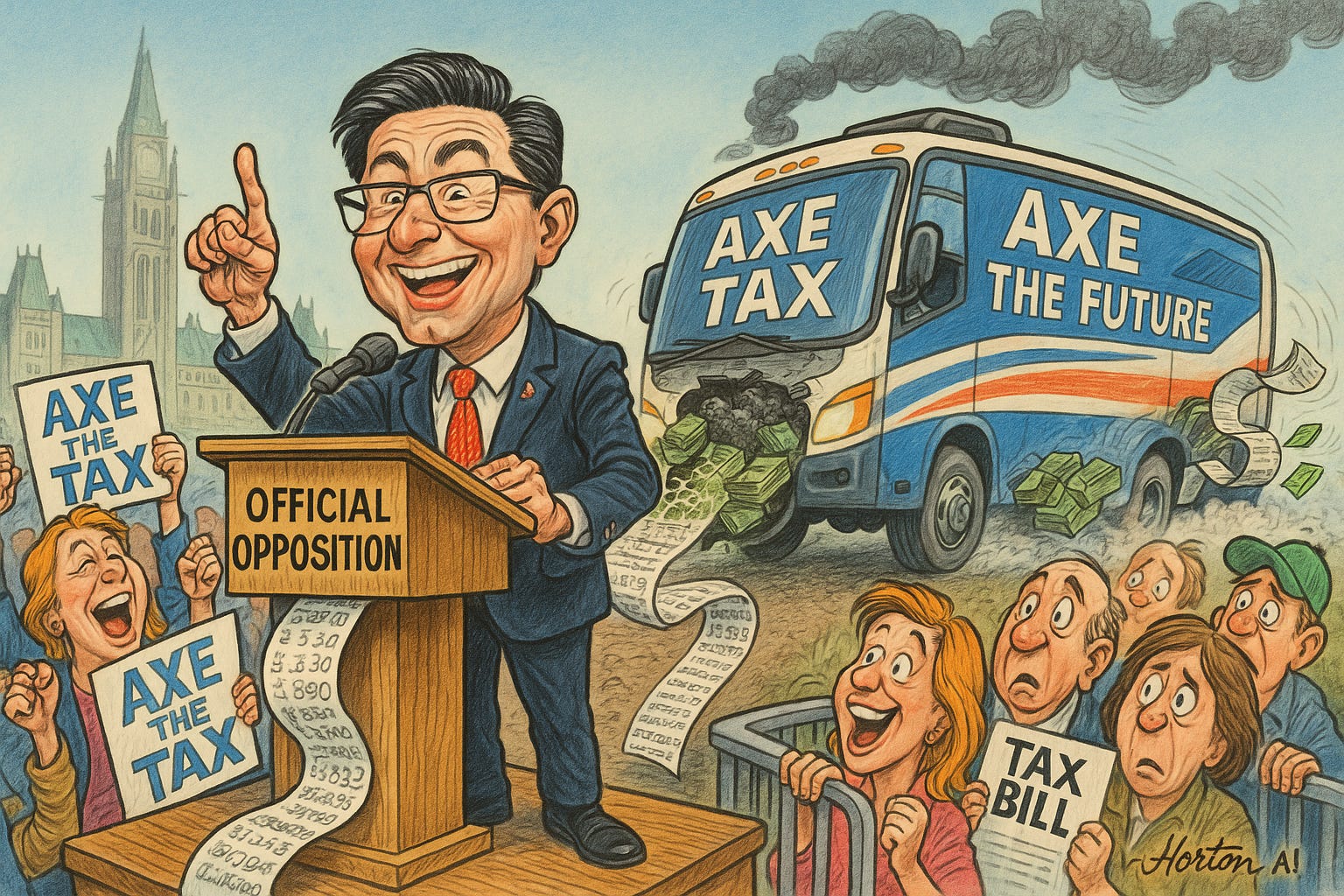
What is it about Pierre Poilievre? Let’s speculate.
He insists he’s nothing like Donald Trump. In interviews — most famously, during the now-infamous “Apple” segment — he plays the innocent. Populism? Never heard of it. Grievance politics? Not familiar.
But anyone who’s watched his rise knows better. The slogans. The smirks. The stunts. The TikTok rage clips. The weaponized press conferences. It’s not just Trump-like. It’s textbook Trump.
And now we learn that while he was running this permanent campaign, we can strongly infer he was doing something else too: charging the public for it.
Much has been made of Poilievre’s record-breaking expenses as Leader of the Opposition. And rightly so. But the real scandal isn’t just the size of the number. It’s what he spent it on. And why. And how public dollars flowed into a machine built not for public service — but for political takeover.
So let’s follow the money. And let’s draw the line that no one else seems willing to.
The Record-Breaking Budget
We've been hearing it from all corners: Pierre Poilievre — the man who built his brand on “fiscal restraint”, who rails against government waste and inflationary spending — quietly presided over the largest spending year by a federal opposition leader in Canadian history.
In 2024, his office racked up $8.83 million in publicly funded expenses. That’s more than double the reported expenses of Prime Minister Justin Trudeau — who, to be fair, draws from additional government sources as head of government. Trudeau was navigating the responsibilities of national leadership. Poilievre, meanwhile, held no executive authority — just two core responsibilities: holding the government to account, and representing his riding.
He did neither well.
Instead, he outspent Trudeau by millions. And more tellingly, he significantly eclipsed the spending of past Opposition Leaders like Andrew Scheer (roughly $4.9 million annually) and Thomas Mulcair (never exceeding $2 million per year, even during a full mandate as Opposition Leader), who fulfilled the same parliamentary role but with far less financial indulgence. Even Jagmeet Singh, another sitting party leader with a recognized caucus and parliamentary status, reported less than half Poilievre’s expenses.
This wasn’t just high spending. It was unprecedented.
So where did all that money go? What does an opposition politician — not a Prime Minister, not a cabinet minister — need $8.8 million for in a single year?
Here’s how the $8.8 million broke down.
According to publicly disclosed House of Commons records, the breakdown of Poilievre’s $8.83 million in spending looked like this:
$7.4 million – Salaries for staff under his Office of the Leader of the Opposition and associated research offices. This figure alone dwarfs the total office spending of MPs and leadership offices.
$659,000+ – Staff salaries specifically within the National Caucus Research Office — an internal team tasked with messaging, strategy, and political communications.
$126,900 – Travel expenses, covering flights, accommodations, and transportation for himself and his staff. This enabled months of national touring framed as parliamentary outreach.
$98,000 – Contracts and consulting services, including professional communications, photography, and speechwriting.
Tens of thousands – Subscriptions and digital tools, including:
NationBuilder – a campaign-style voter engagement and email outreach platform
Meltwater – media monitoring and sentiment tracking
Blacklock’s Reporter – a subscription investigative news service often cited by Conservative MPs
AI tools – including ChatGPT and Claude, likely used for drafting messaging, speeches, or research
Twitter/X Premium – paid features to boost visibility of posts
$749 – Hospitality expenses — a surprisingly modest line, likely for optics
$8,500/month – Security services for his official residence, Stornoway, including monitoring and equipment
Printing and logistics – Multiple contracts with printing companies and event vendors for materials distribution and setup
Taken together, the spending reads like a fully operational campaign headquarters — just one that happened to be funded entirely by Canadian taxpayers, under the title of “Opposition Leader.”
Throughout 2023 and early 2024, Poilievre's aggressive national touring and relentless media messaging suggested he wasn't just preparing for a future election — he was anticipating an early one. With Jagmeet Singh propping up the Liberal minority government, there was growing speculation that Singh might eventually withdraw support and allow a motion of non-confidence to pass.
Poilievre campaigned as if that moment were imminent. Every video, every slogan, every taxpayer-funded stop looked less like parliamentary outreach and more like planting for an early harvest he believed was just around the corner.
That underlying expectation shaped everything that followed — the scale of his outreach, the urgency of his messaging, and the justification for his spending. It helps explain why his Opposition Leader’s budget was used like a campaign fund in waiting: because in his mind, the campaign had already begun.
The Permanent Campaign Model
Donald Trump pioneered the modern permanent campaign — using the machinery of government to perpetually perform as a candidate. Which was planned first? The rally or the official visit? Doesn’t matter because fund flow freely from Public and party coffers. Slogans replaced policy, rallies replaced governing, and the line between public service and self-promotion all but disappeared.
Pierre Poilievre brought that model to Canada.
While he was billing Parliament $8.83 million for "official duties," he was simultaneously drawing from the Conservative Party’s war chest. That means two revenue streams — taxpayer funds and party donations — were flowing into a single, relentless political operation.
The result? A national campaign machine that never paused, never shifted to legislative work, and never returned to the role of constituency representative. His official Opposition Leader’s office covered the travel, the staffing, the logistics, the research, the outreach — while the Conservative Party paid for the professional video crews, the ads, the clickbait headlines, and the social media targeting.
In return for continuously campaigning, the Conservative Party raised a record-breaking $41.7 million in 2024—including $12.8 million in the fourth quarter alone, the most ever raised by any federal party in a single quarter. (For comparison, the Liberals raised $15.2 million in all of 2024, the NDP just $6.3 million.)
What’s more revealing is the donor profile: over 211,000 Canadians gave to the Conservatives, with an average donation of $198. That’s significantly higher than the Liberals’ 118,000 donors at $128 each, or the NDP’s 60,000 donors averaging $105.
While those differences may look modest, they mask the real story. If we assume the typical supporter gives around $100, it’s clear that Pierre’s campaign-style operation attracted major contributions at high-priced fundraising dinners—often charging between $1,700 and $1,750 a plate.
All this while “carrying on the business of the Official Opposition.” The financial upside of campaigning from office is obvious. The ethical line? Less so.
This dual-track system allowed Poilievre to tour Canada, hold rallies, stage high-production-value events, test slogans, and dominate the media cycle — all while claiming it was part of his parliamentary role. No election had been called. No policy agenda was advanced. But the campaign never stopped.
What made this possible wasn’t just ambition. It was structure. The House of Commons provides every Opposition Leader with a generous budget to hold the government accountable. Poilievre used that same allowance to lay the groundwork for his own leadership campaign — and then never took his foot off the gas.
If the Conservative Party had paid for this entire apparatus, it would have been impressive. Still as inappropriate, but impressive. The fact that you paid for half of it should make you ask: How much campaigning are we willing to subsidize?
Poilievre didn’t just run a shadow campaign. He ran the first taxpayer-funded full light of day campaign in Canadian history — without an election being called. It’s the height of narcissistic self-indulgence—too busy seeking admiration and affirmation to actually do a day’s work.
And what’s worse, he imported a political style that has never been considered legitimate in Canadian public life: the permanent populist campaign. Not populist in the sense of fighting for ordinary people — but populist in the sense of demagogic performance, where slogans matter more than facts, and grievance replaces governance.
In Canada, it’s always been understood that you do your job until an election is called. Parliamentarians show up, represent their constituents, propose legislation, attend committees, and contribute to governance. Sure, there’s always some political flair — a town hall here, a slogan there, a few babies to kiss — but those are incidental to the job, not a replacement for it.
Poilievre changed that. He built his entire public identity around not doing the job. The substance of opposition work — questioning ministers, shaping alternatives, engaging with legislation — was hollowed out and replaced with spectacle. The fact that it was underwritten by public money makes it not only cynical, but corrosive.
This was never how Canadian politics worked. Until now.
What Was He Really Building?
The numbers are eye-popping, but it’s the intent behind them that deserves scrutiny. This wasn’t an office budget — it was an engine room. Poilievre didn’t use these resources to legislate, negotiate, or constructively challenge policy. He used them to campaign.
The spending categories reveal an infrastructure tailored to performance:
NationBuilder, a voter mobilization platform typically used for partisan campaigns, not parliamentary service. Appropriate for a party leader (Party Cost) not the leader of the opposition.
Meltwater, a corporate-level media monitoring tool that tracks real-time social media and news coverage — not for informing opposition policy, but for shaping talking points and spinning headlines. Tools like this clearly belong with the party, not the official opposition.
Professional photography, video services, and event staging — not for public record or committee reports, but for leader-centric media moments.
AI writing tools, including ChatGPT and Claude, to churn out speeches, messaging documents, and perhaps even replies. This isn’t research — it’s volume content generation.
Twitter/X Premium, a tool used to boost impressions, visibility, and social media reach — exactly the kind of digital campaigning that’s normally paid for by political parties.
Even the hospitality and travel expenses, modest in appearance, tell a different story when contextualized. A leader with one of the lowest constituency office spends in the country was somehow justifying constant national travel under the banner of official outreach — yet did legislative tours, committee town halls, or policy consultations ever materialize? It was a campaign roadshow, just without the campaign declaration.
And that $7.4 million in staff salaries? That’s a staggering number — more than the total budgets of many House Officers combined. And yet for all that money, there was no extraordinary policy research, no standout legislative initiatives, no breakthrough parliamentary contributions. So what exactly were they doing?
If they were analysts, they were poor ones — incapable of crafting meaningful alternatives or elevating debate. If they were speechwriters, they churned out slogans, not substance. If they were researchers, they seemed focused on headlines, not facts. For a team that outspent all of its peers, the output was remarkably shallow.
Even more telling: records show Poilievre expensed tens of thousands annually to support staff at Stornoway, including funding for a private cook at his official residence. It’s a hard contrast to swallow from a man who publicly champions blue-collar grit and middle-class restraint. When a politician who rails against elites is using public funds to staff a private residence kitchen, something doesn’t align.
The result? A high-cost operation with a low-yield record. The only consistent product of this public investment was partisan messaging — curated, packaged, and pushed out across platforms. Not governance. Not service. Just the machinery of ambition, professionally staffed and publicly funded.
The Riding He Left Behind
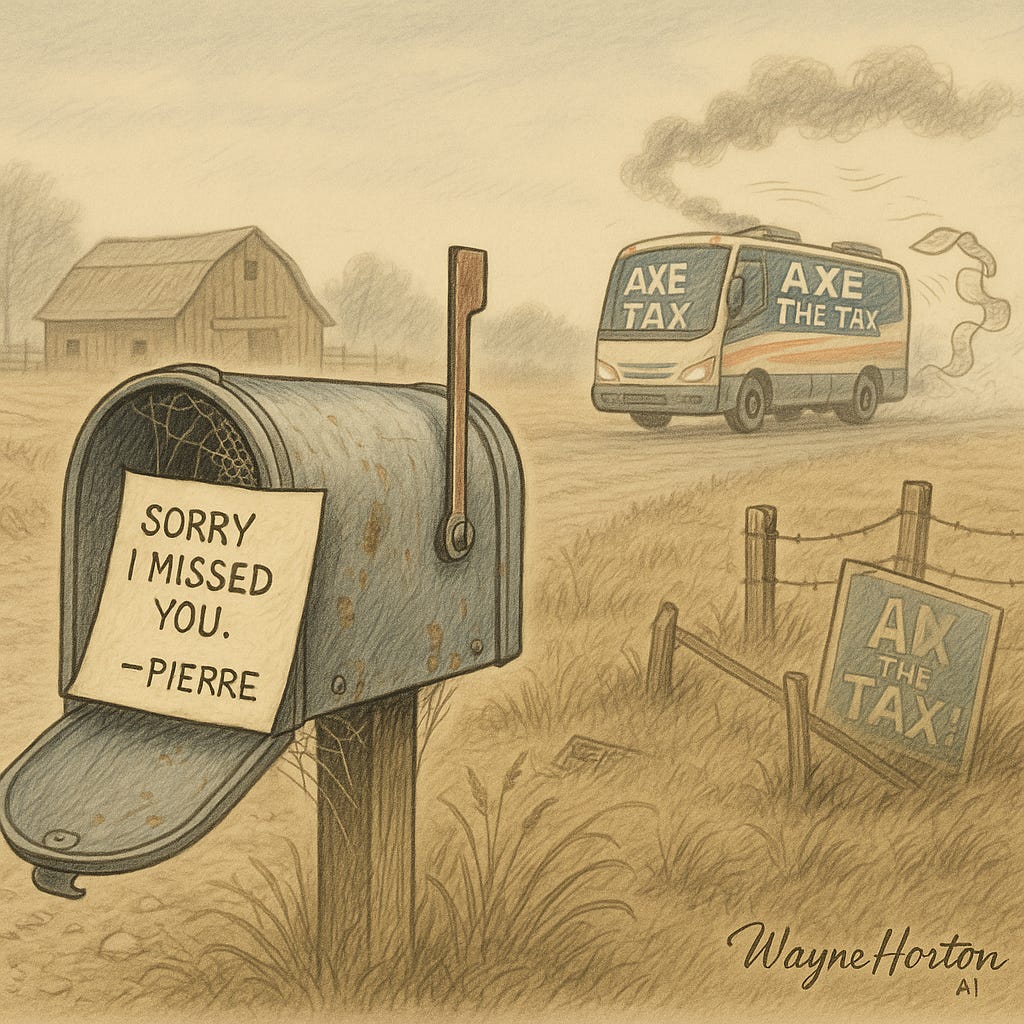
All of this spending — the salaries, the travel, the media tools, the partisan messaging — came at a cost. And nowhere was that cost more evident than in Poilievre’s own riding of Carleton.
In the 2025 election, while the Conservative Party surged nationally, Pierre Poilievre lost his seat. That fact alone should have rung alarm bells. A national party leader losing their own riding during a wave election is almost unheard of — unless the people who know him best had something different to say.
And they did.
Voters in Carleton described an MP who was rarely present. Local media coverage and community forums revealed frustration over a representative who no longer held town halls, no longer met with constituents, and no longer returned calls. Constituency work had seemingly vanished from his list of priorities — replaced by a coast-to-coast spotlight tour masquerading as parliamentary outreach.
His expenses reflect this neglect. While the average MP spent around $550,000 serving their riding in 2024, Poilievre’s total came in at just $241,000 — one of the lowest in the country. That’s not based on efficiency. That’s based on absence.
And it’s worth noting: Carleton had just been redrawn to include more rural, traditionally Conservative communities — making it a safer seat on paper than ever before. In 2022, a federal redistribution shifted the riding’s boundaries. Many of its few remaining urban pockets were reassigned to Kanata, while large rural zones — Fitzroy Harbour, Kinburn, Dunrobin, Constance Bay — were folded in from Kanata–Carleton and Nepean. This made Carleton more rural and arguably more ideologically aligned with Poilievre’s public persona, or at least what should have been his traditional conservative beliefs and agenda.
But even then, the verdict was clear: he had stopped showing up. And when politicians stop showing up, voters don’t forget.
Instead of listening to his constituents, he was speaking over them — through national media blitzes, carefully crafted viral moments, and a political message machine running on public funds. The riding of Carleton didn’t have a Member of Parliament. It had a ghost in a convoy-branded truck stop tour.
His defeat wasn’t a fluke. It was a verdict.
While the country debated his slogans, his own community asked a simpler question: Where was he?
They didn’t need a campaigner. They needed a representative. And when it came time to vote, they didn’t reward the branding. They judged the record.
The System That Let It Happen
This wasn’t just an expensive year. It was an unprecedented abuse of taxpayer resources — one that blurred the line between parliamentary duty and political ambition. So how did it happen?
The short answer: the system allowed it.
The House of Commons allocates millions annually to recognized House Officers — including the Leader of the Opposition — with the expectation that these funds will support the work of holding government to account. But the rules governing that spending are vague, and the oversight is nearly invisible.
At the centre of this problem is the Board of Internal Economy (BOIE) — a secretive, all-party committee that that governs the administrative and financial policies of the House of Commons, setting the rules for MP spending and House Officer budgets. It meets behind closed doors. It reports to no independent body. And its decisions are largely shielded from public scrutiny.
Under these conditions, almost anything can be justified as “outreach.” A rally becomes a town hall. A slogan becomes a research deliverable. Travel across Canada to test political messages becomes a legitimate expense — not because it benefits democracy, but because no one is stopping it.
Watchdogs like Democracy Watch have sounded the alarm for years. They’ve called for independent audits, real-time expense disclosure, and clearer limits on partisan use of parliamentary funds. But the political will — unsurprisingly — has never materialized.
What Comes Next?
What Poilievre did was not inevitable. It was a choice — enabled by loopholes, driven by ambition, and sustained by a system that refuses to police itself. But now that the choice has been made, we all have one to make in return.
Will we let this become the new normal?
Because if this stands — if future Opposition Leaders can bill taxpayers millions for de facto campaign infrastructure while ignoring their legislative and local duties — then the model will replicate. Why wouldn’t it? It works.
Poilievre has already shown that you can tour the country, build a brand, hire a team, and test messages all on the public’s dime. You can neglect your riding, abandon committee work, skip policy contributions, and still rise — as long as the cameras are on and the slogans are sharp.
That isn’t democratic leadership. It’s marketing with a mandate.
And yet, despite losing the confidence of his own constituents in Carleton, the Conservative Party is doubling down. They've become so invested in the Poilievre brand — the image, the contact lenses, the soundbites, the endless rage-fuelled campaign — that they’re preparing to move him to a safer riding: Battle River–Crowfoot. Like Carleton, it’s rural. But unlike Carleton, it’s far from Ottawa. If he couldn’t be bothered to show up for a riding in his own backyard, what makes anyone think he’ll be present for one on the edge of Edmonton?
The truth is, the party can’t afford to let him fail. And Poilievre never planned to serve — only to ascend. He wants to be Prime Minister of our sovereign nation, but he still flirts with Wexit rhetoric and freedom movement theatrics. He’s not a builder. He’s a broadcaster.
One grievance-driven populist has already tested the foundations of a North American democracy. Do we really want a Canadian version — and do we really want to pick up the tab, like Americans still are?
Remember: we paid for part of his populist tirades. Every angry ad. Every tax-funded rally. Every carefully staged grievance moment was partly billed to you.
Every branded tour stop. Every outsourced slogan. Every inflated staff salary paid to polish his image — all of it came from the public purse. If we don’t draw a line now, we’re just underwriting the next one.
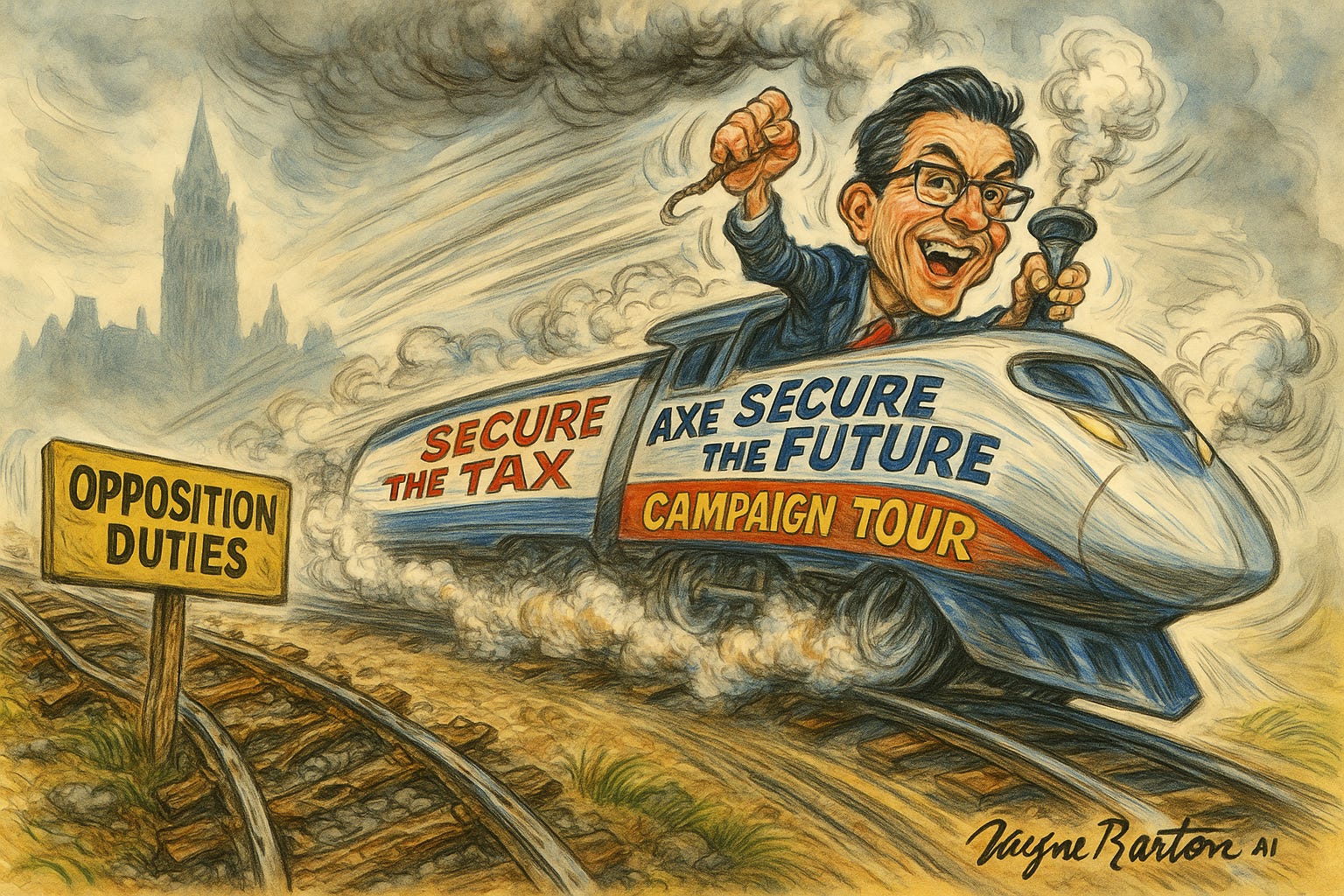
Poilievre didn’t invent the loopholes. But he exploited them more aggressively than anyone before him — a point that cuts to the heart of how the system failed. These weren’t innocent oversights. They were openings wide enough to drive a campaign bus through, and he did — with the door left open by Parliament itself. He showed how the existing rules can be bent to serve personal political ambition, not public service.
And unless those rules are changed, others will follow.
Because if ambition pays and accountability doesn’t, the choice for future leaders will be obvious. And the cost to democracy will only grow.
Thanks for this very valuable research. I hope there is some way to get this to all the Battle River-Crowfoot constituents. But also across the country. Op eds in local newspapers? National papers? And I wonder about a parliamentary petition — I know you need a sponsor, but maybe Bruce Fanjoy? The aim of the petition would be to place a structure around the spending of the Opposition leader, so this kind of arrogant entitlement can’t do so much damage.
We are fortunate to have dodged the Poilievre Maple MAGA bullet, but the fanatics are still lurking in the weeds. Us Canadians need to be ever vigilante.